• Home
  • Tragedy
    • Unequal Education
  • The Educator & The Philanthropist
    • Booker T. Washington
    • Julius Rosenwald
    • A Historic Meeting
  • Schools
    • The First Six
    • Partnering with the Community
    • Expanding the Vision
    • Gallery of Rosenwald Schools
  • Rosenwald Fund
    • Investment in People
  • Triumph
    • Gallery of Rosenwald Graduates & Fellows
    • Timeline
  • More
    • Conflicting Opinions
    • Conclusion
    • Documents >
      • Process Paper
      • Annotated Bibliography
      • End Notes
  My site
  • Home
  • Tragedy
    • Unequal Education
  • The Educator & The Philanthropist
    • Booker T. Washington
    • Julius Rosenwald
    • A Historic Meeting
  • Schools
    • The First Six
    • Partnering with the Community
    • Expanding the Vision
    • Gallery of Rosenwald Schools
  • Rosenwald Fund
    • Investment in People
  • Triumph
    • Gallery of Rosenwald Graduates & Fellows
    • Timeline
  • More
    • Conflicting Opinions
    • Conclusion
    • Documents >
      • Process Paper
      • Annotated Bibliography
      • End Notes
Picture

"It is a crime to pile up money after one has accumulated all that he needs for himself and his family. There is a stage where acquisition becomes a vice." - Julius Rosenwald, 1918 [57] 

The Rosenwald Fund

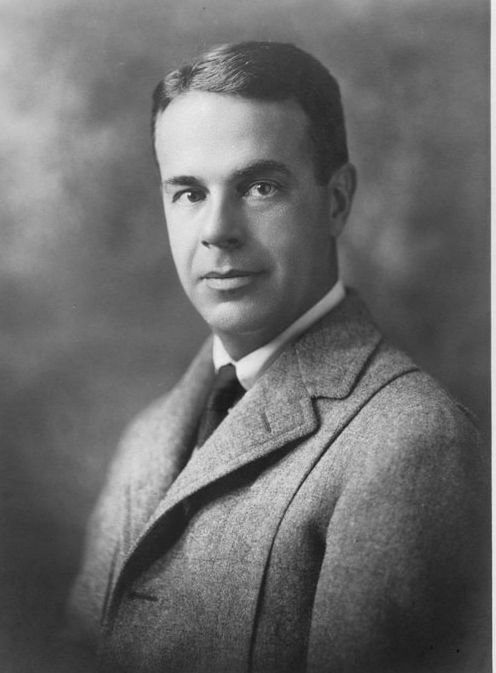
Top photo: n.d., Goat Hill History.
Picture
Picture
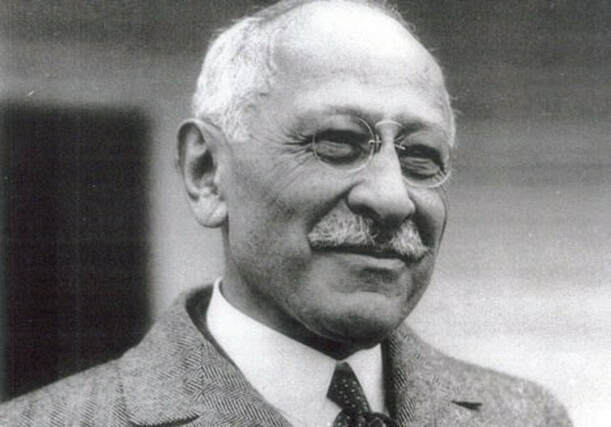
Edwin Embree. n.d., Rockefeller Foundation.
Picture
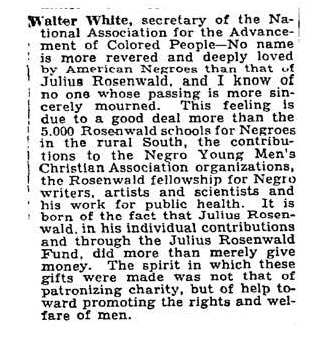
"No name is more revered and deeply loved by American Negroes than that of Julius Rosenwald, and I know of no one whose passing is more deeply mourned." Walter White, secretary of the NAACP. January 17, 1932, New York Times.

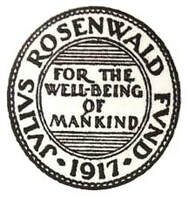
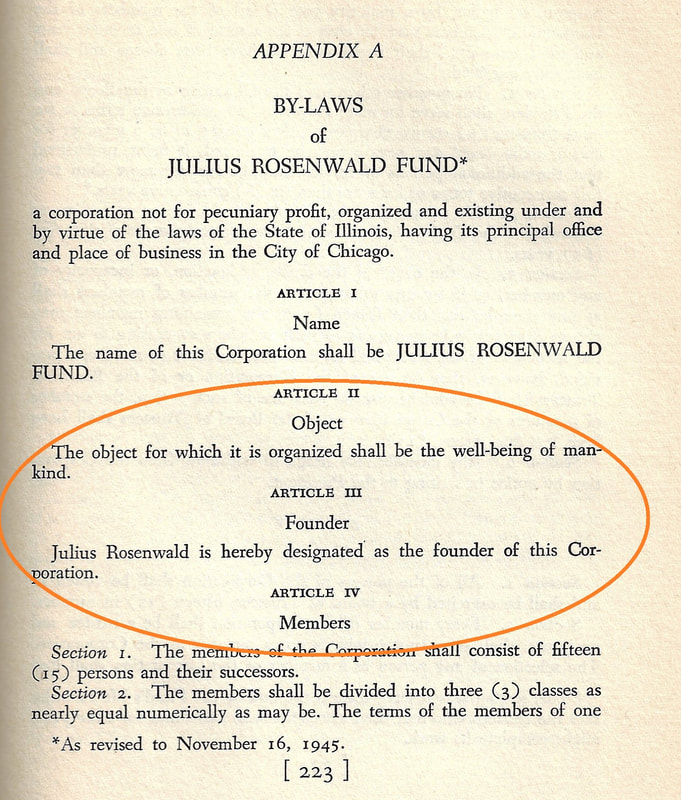
Rosenwald established the Rosenwald Fund in 1917 for "the well-being of mankind." 

To maximize its impact, the fund had no endowment. Rosenwald decreed that all monies had to be spent within 25 years of his death. He thought that funds should have the largest impact possible at the time it was needed, and he believed that others would pick up his mantle and continue to give in the future. 
​

​"I am not in sympathy with...perpetuating endowment and believe that more good can be accomplished by expending funds as trustees find opportunities for constructive work than by storing a large sum of money for long periods of time...Coming generations can be relied upon to provide for their own needs as they arise." - Rosenwald, 1919, in Embree and Waxman [58] 

In 1928, Rosenwald and Edwin Embree, whom Rosenwald chose to run the Fund, created the Rosenwald Fellowship, to provide grants to African-American artists, scientists, and scholars.*
(*The Fund also provided grants to white southerners, primarily those involved in race relations.)

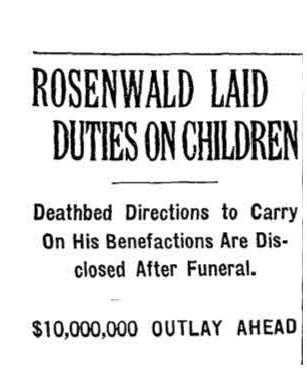
Rosenwald died in 1932, but he directed Edwin Embree and his children to continue his work, according to his vision.

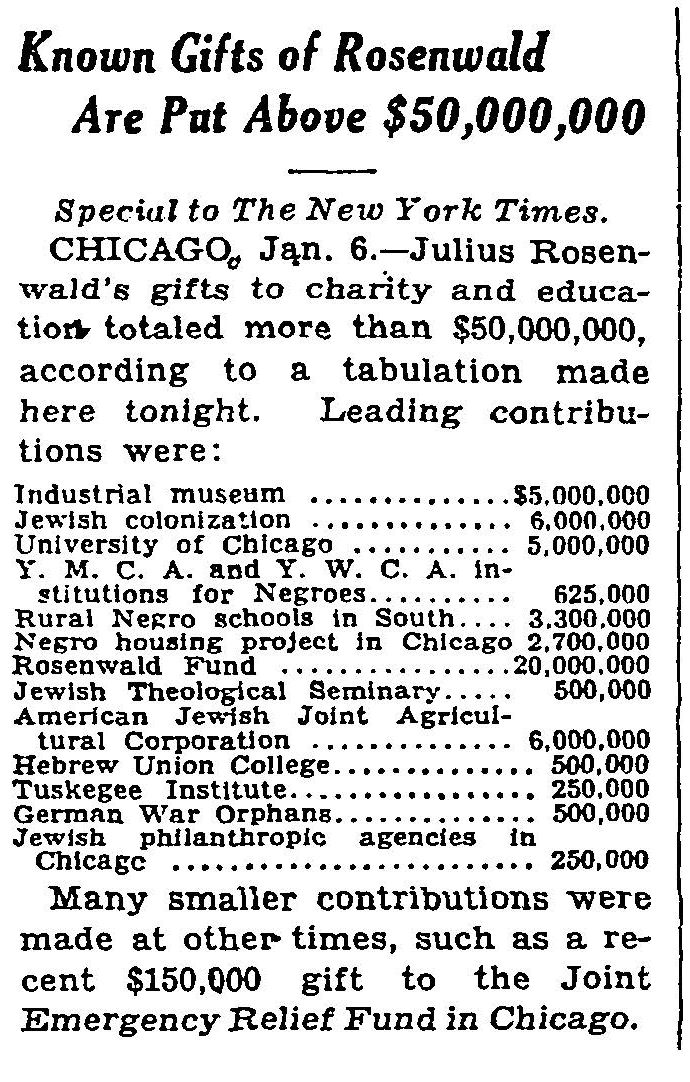
At the time of his death, Rosenwald donated over $50,000,000* and the Fund would continue giving fellowships until it closed in 1948.  (*Close to $1 billion in today's dollars. Approximately half of Rosenwald's philanthropy went to African-Americans.)

"He wanted dollars to be spent for clear needs today rather than left to accumulate until they had multiplied even a hundredfold for possible uses in the remote future." - Embree and Waxman [59]
PictureEmbree and Waxman, Investment in People.

"I can testify that it is nearly always easier to make $1,000,000 honestly than it is to dispose of it wisely."  - Julius Rosenwald, 1929, in Schulman. [60]

Picture
January 6, 1932, New York Times.
Picture
January 8, 1932, New York Times.
Picture
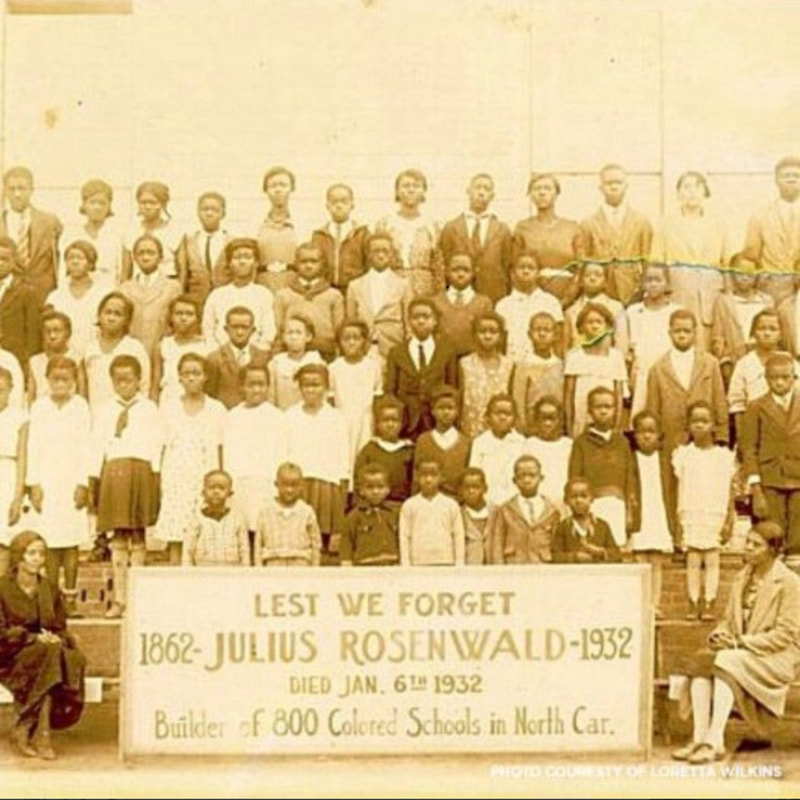
Rosenwald School students in North Carolina recognizing the passing of Rosenwald. 1932.
learn about the investments in people made by the rosenwald fund >
Proudly powered by Weebly
  • Home
  • Tragedy
    • Unequal Education
  • The Educator & The Philanthropist
    • Booker T. Washington
    • Julius Rosenwald
    • A Historic Meeting
  • Schools
    • The First Six
    • Partnering with the Community
    • Expanding the Vision
    • Gallery of Rosenwald Schools
  • Rosenwald Fund
    • Investment in People
  • Triumph
    • Gallery of Rosenwald Graduates & Fellows
    • Timeline
  • More
    • Conflicting Opinions
    • Conclusion
    • Documents >
      • Process Paper
      • Annotated Bibliography
      • End Notes